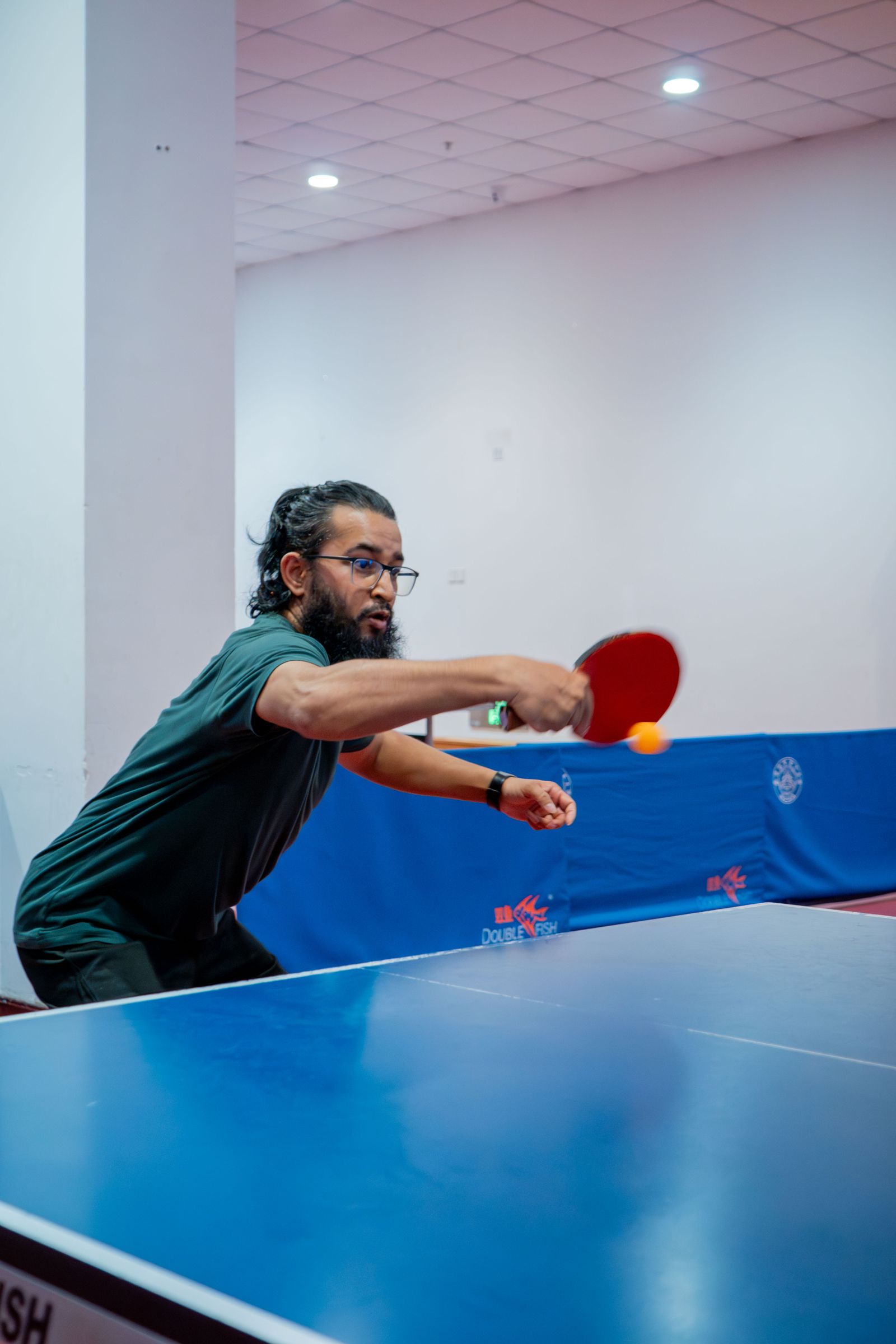
A Tired Brain Lands Harder: Mental Fatigue Raised Side-Impact Forces 23% in Table Tennis Players
A randomized crossover trial with 24 competitive table tennis players found that 45 minutes of mentally draining cognitive work delayed their on-table decisions and made their footwork landings stiffer and harder — peak side-to-side ground forces rose 23% and impact loading rates rose 17%, a pattern the authors link to elevated lower-limb injury risk.
DRAFT ARTICLE - Ready for Review
Most table tennis players think of fatigue as a leg problem. You run out of gas, your footwork slows down, your legs feel heavy. A new study published in Frontiers in Psychology flips that assumption on its head: it is not tired legs that change how you move on the table — it is a tired brain. And the change is not just slower. It is riskier.
In a randomized crossover trial, researchers from Nanjing Sport Institute and Nanjing Normal University showed that 45 minutes of mentally draining cognitive work — the kind a student does before evening practice, or a professional does during hours of tactical video analysis — made competitive table tennis players land their footwork steps harder, stiffer, and with meaningfully higher forces passing through their ankles and knees.
The Study
Twenty-four collegiate table tennis athletes (12 men, 12 women) each completed two experimental sessions in randomized order, separated by a washout period. In one session, they performed a demanding 45-minute Stroop color-word conflict task — a lab-standard way to induce mental fatigue. In the other, they watched a 45-minute emotionally neutral documentary as a control.
The manipulation worked, and the researchers verified it from two directions. Subjective mental workload on the NASA-TLX scale nearly tripled after the Stroop task (76.6 versus 25.8 out of 100, p < 0.001). Objectively, players’ error rate on the Stroop task itself climbed from under 5% in the first ten minutes to over 20% in the final ten minutes (p < 0.001) — clear evidence of declining cognitive function by the end.
Then came the table. Each player performed a choice-reaction chasse-step forehand topspin task — reacting to a light signal and stepping sideways to strike a delivered ball — while 3D motion capture and force plates recorded every joint angle, joint moment, and ground reaction force.
The Numbers
The cascade started in the brain, not the legs.
Mental fatigue significantly prolonged premotor time — the interval between the signal and the first muscle activation, essentially the decision window (d = 4.26, p < 0.001). Players under mental fatigue thought slower. To compensate, their actual movement phase compressed: chasse-step completion time got significantly shorter under fatigue (d = 6.03, p < 0.001). The authors describe this as a “cognitive-motor time compression effect” — the brain eats into the movement’s time budget, and the body rushes to make up the difference.
That rush showed up in the landing mechanics:
- Peak vertical ground reaction force rose 8.5% during initial landing — from 1.41 to 1.53 times body weight (p = 0.001, d = 0.75)
- Vertical loading rate — how fast that force hits — rose 17%, from 34.7 to 40.5 body weights per second (p < 0.001, d = 0.97), the largest biomechanical effect in the study
- Peak side-to-side (mediolateral) ground force rose 23% during post-stroke stabilization — from 0.52 to 0.64 times body weight (p < 0.001, d = 0.93)
- The ankle stiffened: maximum dorsiflexion during landing decreased (21.2° versus 21.9°, p = 0.011, d = 0.57), meaning players absorbed less impact through the joint
- The knee stiffened too: minimum knee flexion during stabilization dropped from 46.9° to 43.6° (p = 0.002, d = 0.72), a more rigid, less shock-absorbing posture
- Peak knee extension moment during landing fell 10.5% (p = 0.003, d = 0.67) — the knee was less able to control the landing
During the push-off phase, fatigue cost power: peak hip extension velocity (d = 1.42), knee extension velocity (d = 0.94), and knee extension moment (d = 1.08) all dropped significantly.
Put simply: mentally fatigued players decided later, moved more frantically, and slammed into the floor with less shock absorption — the exact biomechanical signature sports scientists associate with overuse and acute lower-limb injury risk.
Why This Fits the Bigger Picture
This is not a one-lab oddity. A 2021 study in the International Journal of Environmental Research and Public Health found that mental fatigue measurably degraded table tennis stroke performance and prolonged visuomotor reaction time, backed by EEG evidence of altered brain activity. And a 2024 systematic review in BMC Sports Science, Medicine and Rehabilitation concluded that mental fatigue reliably impairs performance outcomes across racket sports, including table tennis. What the new Nanjing study adds is the missing half of the story: it is not only that mental fatigue makes you play worse — it changes the physical forces your body absorbs while doing it.
Honest Caveats
The behavioral effect sizes (d values above 4) look enormous, but the authors transparently note that their within-subject dz formula mathematically inflates effect size magnitudes compared to independent-group benchmarks; those values reflect high consistency of the manipulation, not superhuman shifts. The 24-player sample is collegiate-level athletes, generalizing to recreational players needs confirmation, and the biomechanical p-values were uncorrected paired t-tests, with more conservative Bonferroni-adjusted values provided in the study’s supplementary material. Even so, the force-plate findings — the core of the injury argument — had p-values at or below 0.002 before adjustment.
What This Means for Your Practice
- Schedule hard footwork early. Demanding reactive and multi-ball drills belong at the start of practice — before tactical video sessions, long coaching talks, or (for students) heavy study days, not after.
- Treat mental drain as a physical risk factor. If you arrive at the club after a mentally exhausting day, extend your warm-up and be cautious with intense lateral movement drills.
- Coaches: watch the brain, not just the legs. A player who looks physically fresh but is mentally fried may be moving with subtly riskier mechanics. Cognitive state belongs in load monitoring alongside volume and intensity.
The takeaway is refreshingly practical: in table tennis, the path to safer footwork runs partly through rest for the mind.
Peer-Reviewed Sources
- Li Q, Meng L, Wang Y, Wang Y, Yang Z. Delayed decision, harder landing: how mental fatigue alters reactive step biomechanics and joint loading in table tennis players. Frontiers in Psychology. 2026;17:1871714. DOI 10.3389/fpsyg.2026.1871714. PMID 42890198. ↗
- Habay J, Proost M, De Wachter J, Díaz-García J, De Pauw K. Mental Fatigue-Associated Decrease in Table Tennis Performance: Is There an Electrophysiological Signature? International Journal of Environmental Research and Public Health. 2021;18(24):12906. DOI 10.3390/ijerph182412906. PMID 34948514. ↗
- Ding C, Soh KG, Sun H, Roslan S, Cao S. Does mental fatigue affect performance in racket sports? A systematic review. BMC Sports Science, Medicine and Rehabilitation. 2024;16:179. DOI 10.1186/s13102-024-00963-w. PMID 39187902. ↗